

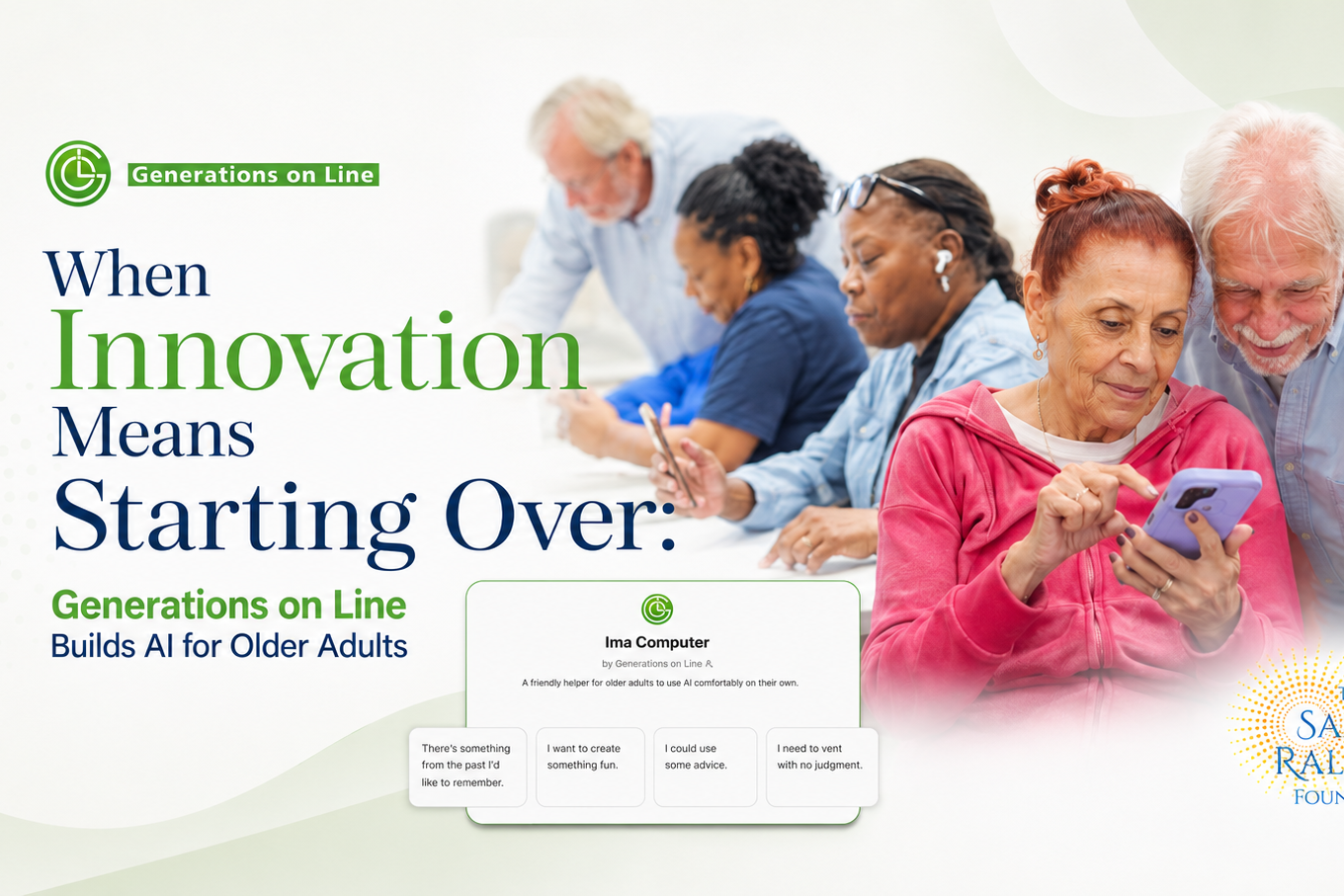
Rather than assuming what older adults wanted from AI, Generations on Line began by asking them.
Generations on Line began by asking them.The organization conducted five focus groups at sites serving older adults who might face financial, social or technological barriers: John C. Anderson Apartments, affordable housing for LGBTQ+ older adults; the William Way LGBT Community Center; Germantown Apartments, part of NewCourtland’s affordable senior housing; and two Federation Housing communities for low-income older adults, Reider House and Goldsteins’ Rosenberg Residence in Northeast Philadelphia.
The first surprise was that participants were far more receptive to artificial intelligence than the team had anticipated.
According to Dichter, 67 percent of participants said they felt somewhat or very positive about AI.
That gave Generations on Line a place to begin—but not a finished product.
The organization developed what would eventually become IMAComputer.org, a training program and conversational AI experience created specifically for older adults. It included introductory videos, guidance about safety, explanations of generative AI and an interface designed around the ways older adults actually approach technology.
The development process was highly iterative. The team conducted pre- and post-testing, returned to participants with prototypes, revised its training around two-factor authentication, and continued changing both the curriculum and the underlying architecture of the interface—what was taught, how it was taught and how interactive the experience could become.
At one point, Dichter said, the team essentially decided to “tear it up and start over.”
That, in many ways, was the innovation.
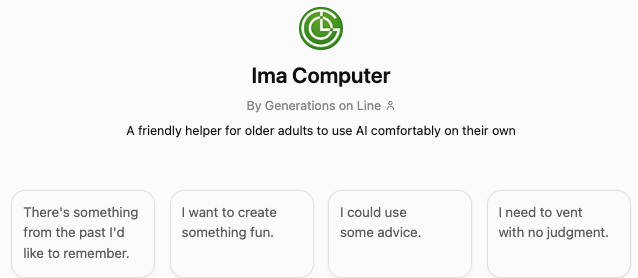
So the team built IMA around older adults rather than asking older adults to adapt to conventional AI.
Early testing explored dozens of possible conversation prompts before the organization narrowed them to a small number that users found approachable. They were: “There’s something from the past I’d like to remember,” “I want to create something fun,” “I could use some advice,” and “I need to vent with no judgment.”
That last one proved especially popular during pilot interviews.
Another lesson came from the way people interacted with the system. Many initially typed their responses because that was how they believed a computer was supposed to work. Once participants realized they could simply talk, the experience became much more natural.
Generations on Line now plans to emphasize voice interaction even more prominently.
The tool can also help with very practical tasks. An older adult might ask for ideas for a birthday gift, create a meal plan, develop a shopping list, or adapt meals around allergies. But the goal is not simply to reproduce a general-purpose chatbot.
IMA was intentionally configured to respond in ways that better suit older users: allowing more time, avoiding unnecessary interruption and repeatedly reinforcing safe use.
When asked how she works differently from a regular ChatGPT conversation, IMA herself offered a succinct explanation:
“The simplest way I’d put it is: your regular ChatGPT is a general-purpose assistant; IMA is ChatGPT that has been given a very specific job, audience, and manner of speaking. In this case, IMA has been instructed to behave especially well with older adults who may feel uncertain about technology. So compared with your ordinary ChatGPT conversation, I’m deliberately more likely to explain things in plain language, break procedures into small steps, avoid technical jargon, reassure someone who is worried about making a mistake, and call attention to scams, privacy, suspicious links, and other internet-safety issues.”
 One of the most significant developments came in the project’s second year.
As Generations on Line continued refining the system, it became clear that conversational AI could help address another longstanding digital barrier: language.
If a participant speaks to IMA in Spanish, the system can respond in Spanish. The same is true for Russian and other supported languages.
For Generations on Line, that capability opened an entirely new avenue for reaching older adults who had often been excluded from digital-skills programming because of language barriers.
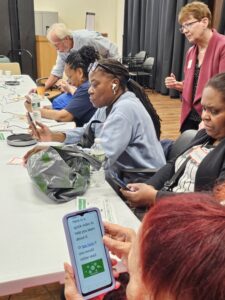
Dichter recalled one training session conducted in Spanish in which a participant began skeptical of the technology. Midway through the session, the woman suddenly blurted out:
“I need this in my life.”
It was the kind of reaction the team had hoped for—not enthusiasm for technology simply because it was new, but recognition that the technology could actually be useful.
 The numbers emerging from the project suggest that reaction was not unusual.
Interest in AI rose from 67 percent before participation to 94 percent afterward, according to Generations on Line’s post-program surveys. Eighty-seven percent said they would recommend the experience to a friend.
After launching at partner sites, IMA has now reached approximately 334 beta testers.
The pilot expanded beyond the original focus-group locations to include the Philadelphia Senior Center and other community partners, giving the Generations on Line team additional opportunities to observe how older adults interacted with both the training and the technology.
Those numbers are still relatively modest, but the structure of the program points toward much broader reach.
Because IMA does not require a fixed physical program site or a one-to-one staffing model, the potential capacity is enormous. Generations on Line envisions expanding access throughout Philadelphia through libraries, senior centers and other community settings, as well as eventually reaching people directly.
“What we have created has infinite capacity,” Dichter said.
And because the program is free, scale does not necessarily have to mean creating another financial barrier for the older adults it was designed to reach.
Generations on Line has also developed a coaching guide and other training materials to help community organizations support older adults as they learn to use IMA, extending the project beyond the technology itself.